Many businesses—especially family-owned ones—achieve significant success in their early years without any formal governance framework, only to later face challenges with decision-making, overlapping roles, and ownership disputes between generations. Governance is not a management luxury or a formality. It is the tool that protects the business from these risks and ensures its long-term continuity. In this article, Consulting Group (CGroup) walks through the concepts of corporate governance and family governance, their most important tools, and why every family business needs them.
What Is Governance?
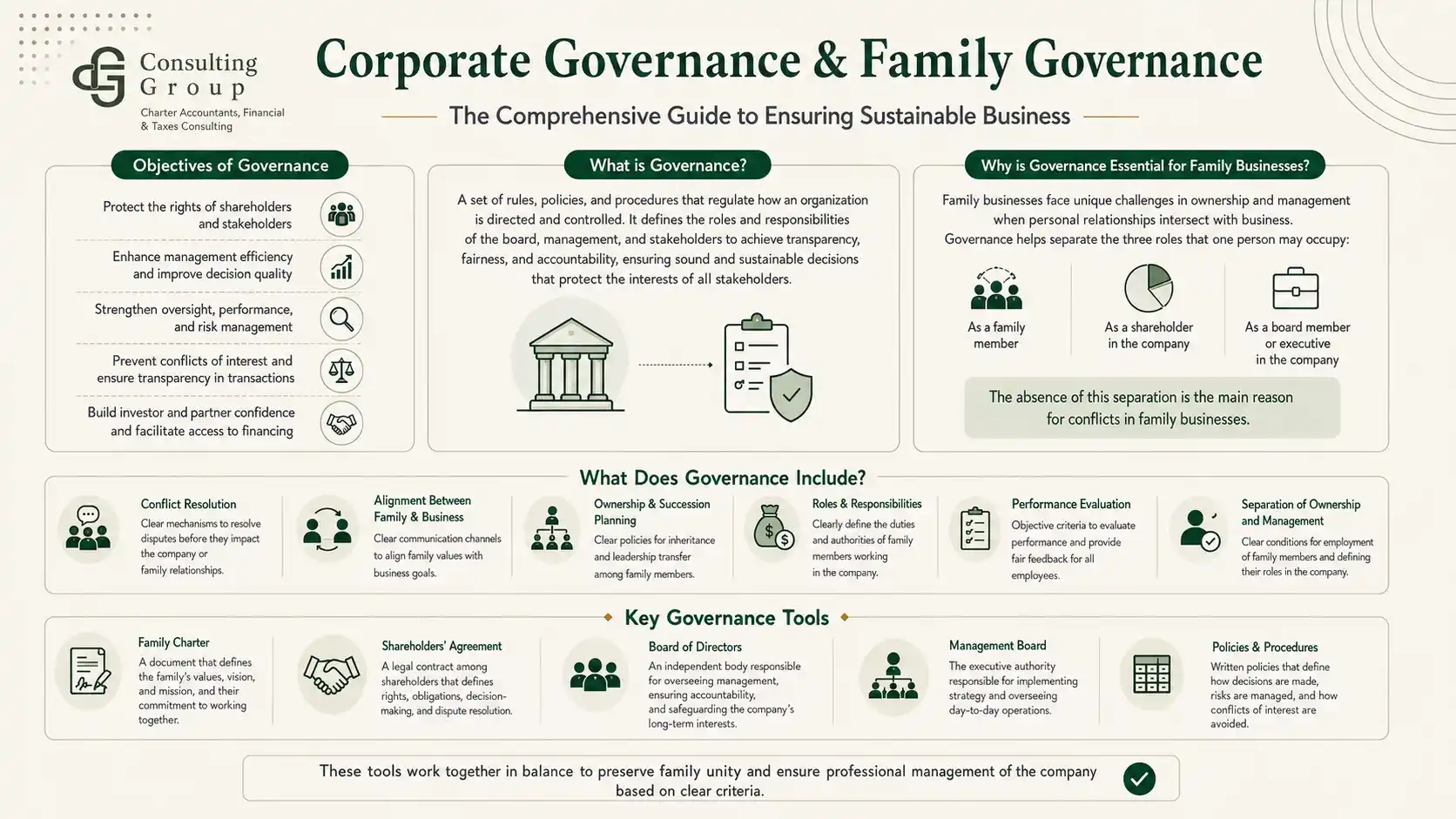
Governance is a system of rules, policies, and procedures that regulate how an institution is managed. It clearly defines the roles, responsibilities, and authorities of every party within the organization. This system aims to achieve transparency, fairness, and accountability, and ensures that decisions are made in a structured, institutional manner—free from randomness or conflicts of interest.
Governance Objectives
- Protecting the rights of shareholders and stakeholders
- Improving management efficiency and the quality of decisions
- Strengthening oversight of performance and risk
- Preventing conflicts of interest and ensuring transparency in dealings
- Building the confidence of investors, partners, and lenders in the company
Family Governance: When Does It Become a Necessity?
Governance is especially critical in family businesses, where family relationships overlap with ownership and management in ways that are difficult to untangle without a clear framework. Family governance is the framework that regulates the relationship between family members on one side, and the company’s ownership and management on the other.
Its core objective is a clear separation between three roles that may be held by the same individual: their role as a family member, their role as a shareholder in the company, and their role as a board member or executive employee. The absence of this separation is the most common cause of disputes in family businesses—family decisions mix with management decisions, and holding people accountable for performance becomes difficult when the person being evaluated is a family member.
What Does Family Governance Cover?
Family governance establishes clear, written policies governing multiple aspects of the relationship between the family and the company, most notably:
- Employment criteria: Conditions and standards for accepting family members into roles within the company
- Promotion and evaluation: Objective criteria for evaluating performance and promoting family members, on the same basis as any other employee
- Compensation: The basis for determining salaries and bonuses for family members working in the company
- Ownership transfer and succession: Clear mechanisms for transferring shares and assuming leadership positions between generations
- Intergenerational relations: Formal communication channels that limit the spillover of personal disputes into the company
- Dispute resolution: Pre-agreed mechanisms for addressing conflicts before they escalate and affect the company’s continuity or the family’s cohesion
Key Tools of Family Governance
Family Charter
A document the family collectively agrees upon, defining shared values, the family’s vision for the company, and the general rules governing members’ relationship with it.
Shareholders Agreement
A legally binding contract between partners that defines each party’s rights and obligations, mechanisms for dealing with ownership stakes, and methods for resolving shareholder disputes.
Family Council
A separate body from the Board of Directors, dedicated to discussing family matters related to the company, so that family discussions do not carry over into executive management meetings.
Board of Directors
The body responsible for strategic decisions and oversight of executive management. It is preferable to include independent members from outside the family to enhance objectivity.
Authority Matrix
A document that precisely defines who holds the right to make each type of decision and the limits of each authority, preventing overlap or duplication in decision-making.
Together, these tools provide a balance between preserving family unity and ensuring the professional management of the company, free from personal considerations.
Why Does Your Family Business Need Governance Now?
The true measure of a family business’s success is not profits alone, but its ability to endure and transition successfully from one generation to the next. Many successful family businesses stumble specifically at the point of leadership transition—not due to any weakness in the business itself, but due to the absence of a governance framework that defines how that transition should be managed. In this sense, governance is an essential tool for building a strong, sustainable institution that preserves both the family’s wealth and its relationships.
For advisory services that support building this framework, explore CGroup’s Corporate Advisory Services.
Frequently Asked Questions about Corporate and Family Governance
1. What is the difference between corporate governance and family governance?
Corporate governance is a general framework that regulates the management of any company, regardless of ownership type, focusing on transparency, accountability, and oversight. Family governance is an additional framework specific to family-owned businesses, focused on separating family roles from management roles and organizing the transfer of ownership between generations.
2. Is governance mandatory for all companies in Egypt?
Certain laws and regulations—particularly those governing joint-stock companies and companies listed on the stock exchange—require the implementation of specific governance rules. For family businesses and unlisted limited liability companies, governance is optional from a legal standpoint, but it has become an essential practice for any company seeking growth, external financing, or outside investment.
3. When should a family business start implementing governance?
The ideal time is before any dispute or crisis occurs, not after. Many companies begin thinking about governance as leadership transitions to the next generation approach, but it is best to establish this framework early—even if the company is still in its early stages.
4. What is a Family Charter and is it legally binding?
A Family Charter is a document expressing the family's shared values and vision for their business. It is primarily a moral agreement rather than a legally binding contract. The Shareholders Agreement, on the other hand, is the document that carries legal binding force between the partners.
5. Who creates the Authority Matrix in a family business?
The Authority Matrix is typically developed jointly by the Board of Directors and the executive management. External advisory expertise is often engaged to ensure objectivity and prevent decision-making bias in favor of any party within the family.
6. Is it necessary to have independent board members in a family business?
Yes, having independent members from outside the family on the Board of Directors enhances objectivity in decision-making, brings in external expertise and perspectives, and reduces the likelihood that family considerations will overshadow the company's strategic interests.
Do you need help building a governance framework for your business?
Consulting Group (CGroup) helps family businesses design their own governance frameworks—from drafting the Family Charter and Shareholders Agreement to building the Authority Matrix and organizing the Family Council and Board of Directors.
Contact Us to Discuss Your Company's Needs →