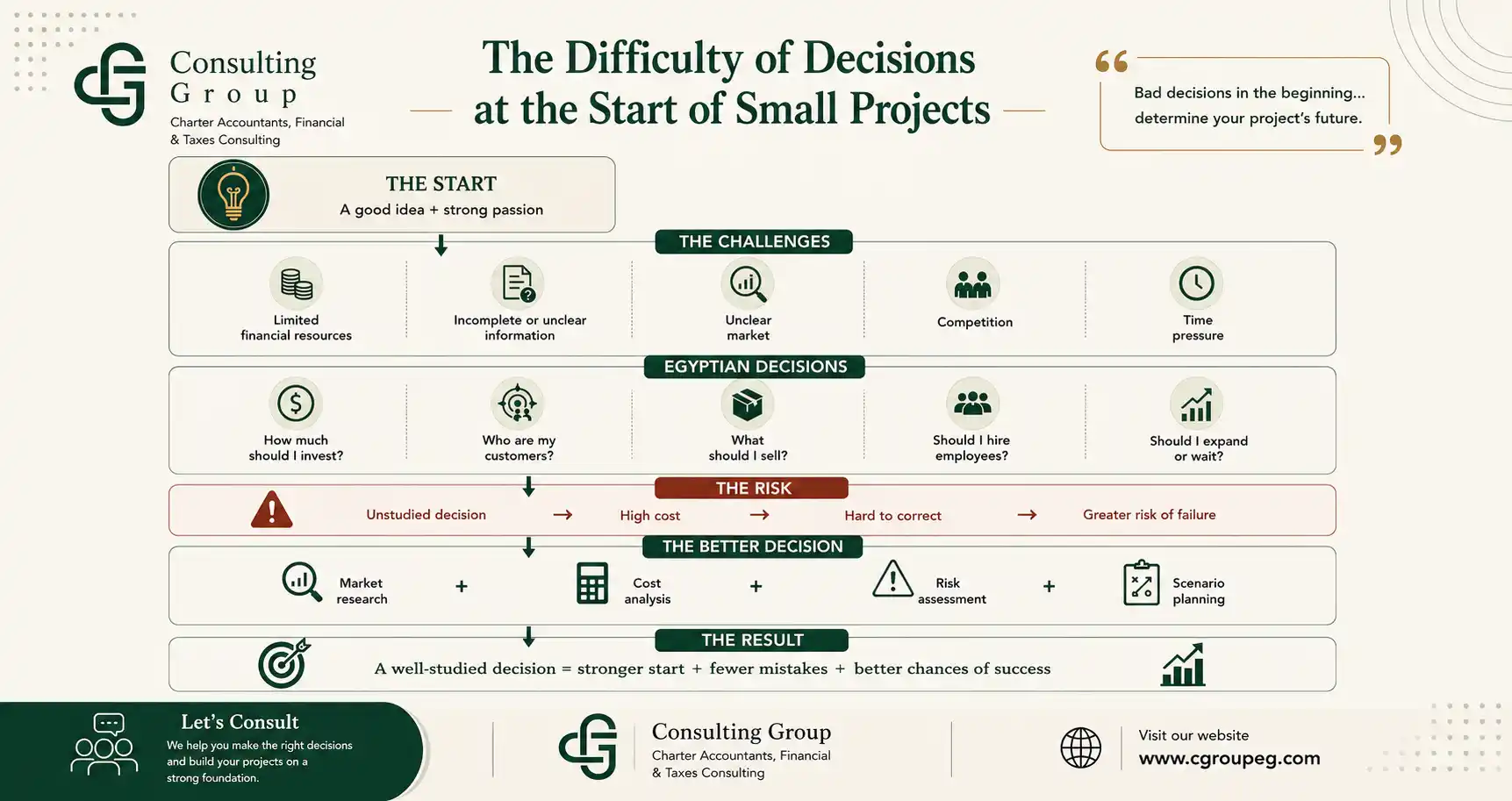
The early stages of a small business are filled with hard decisions. Resources are limited, information is incomplete, and the market may not yet be clear.
The Decisions You Face at the Start
Should I start now? How much should I invest? Who are my customers? Should I hire? And when do I scale?
These are not abstract questions—every wrong answer carries a direct cost: wasted time, money spent on the wrong thing, or an opportunity missed. That is why relying on enthusiasm or intuition alone is not enough.
What Helps You Decide with More Clarity?
Market research gives you real data on demand size, competitors, and target customer behavior, replacing assumptions with actual evidence.
Cost analysis reveals your break-even point and helps you determine whether your business model can sustain itself under current market conditions.
Risk identification puts the possible scenarios in front of you—optimistic, neutral, and pessimistic—so you are prepared rather than caught off guard.
Scenario planning gives you a margin to maneuver if revenue is delayed or market conditions shift.
At the start of a business, a well-considered decision may matter more than the size of your capital. Businesses don't always fail because of underfunding—they often fail because of early, uncalculated decisions.
Frequently Asked Questions about Decision-Making in Small Business Startups
1. Why are decisions at the start of a business so difficult?
Because resources are limited and information is incomplete at the same time. The business owner faces multiple interrelated decisions simultaneously—from pricing and hiring to expansion and funding structure—without any operational track record to rely on.
2. Is market research necessary before starting a business?
Yes. Market research gives you real data on demand size, competitors, and target customer behavior, turning decisions from guesses into informed estimates. Businesses that skip this step often discover later that the market wasn't what they imagined.
3. What are the most critical decisions a small business owner faces at the start?
The main ones are: Should I start now or wait? How much should I invest in the first phase? Who exactly is my target customer? Should I hire or work alone initially? And when is the right time to scale? Each of these decisions has direct operational and financial consequences.
4. How does cost analysis help with the decision to start a business?
Cost analysis reveals your break-even point—the sales or revenue you need to cover your costs—and helps you determine whether your business model is viable under current market conditions or needs adjustment before launch.
5. What does scenario planning mean when starting a business?
Scenario planning means preparing three performance estimates: optimistic, neutral, and pessimistic. This keeps you prepared for different outcomes instead of building on a single assumption that may not hold, and gives you room to maneuver if revenue is slower than expected.
6. When does a small business owner need external consulting?
When facing an important decision that involves intertwined financial, legal, and operational factors—such as choosing the company's legal structure, setting a pricing model, deciding on expansion, or when financial projections feel unclear. Consulting at this stage meaningfully reduces the cost of mistakes.
If you're at the start of your business and need clearer vision before a major decision, consult us.
Consulting Group (CGroup) helps you analyze your situation, evaluate your options, and make informed decisions you can build your business on with confidence.
Contact Us →